


The process of improving business process performance should always be at the top of your agenda, as I keep saying, if you are not improving you are going backwards. In this world, change is the only constant so you…
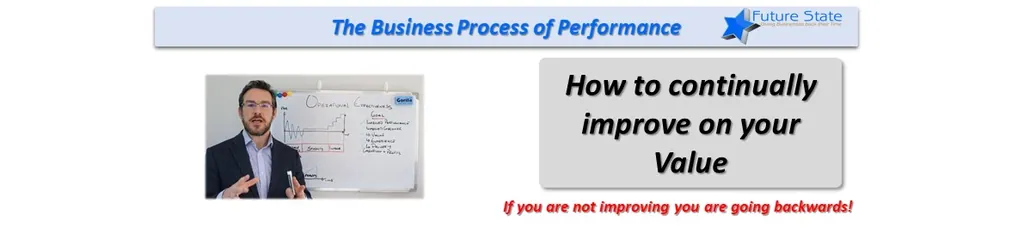
The process of improving business process performance should always be at the top of your agenda, as I keep saying, if you are not improving you are going backwards. In this world, change is the only constant so you always need to be ready and prepared for what change is coming, for good or bad, and the best way to achieve this is through business process optimisation, WHY?
- The more optimised you are, the quicker you will adapt to change
- Your cash flow will be strong
- Your profits will be strong
- Your people will be more resilient
- to name but a few…
I was lucky enough to have a great mentor in all things performance during my time with a company called SA Partners and they had some great ways of visualising the journey of process improvement, the one in this video being one of my favourites. Targets should continually reviewed, always asking questions like
- How can we do things better?
- How can we do better things?
- Are we truly helping our customers and solving their pains?
The more you ask these questions the more you will improve and along with that, the more you will reduce the cost of unsolved issues over time which can have serious consequences on your business. Remember any activity that is not adding value to your customer is considered a waste, albeit necessary or not.
This is a simple strategy that can implemented with ease however can have a substantial impact on your bottom line!
Part one
Operations Effectiveness – Video Transcript
Part two
Hi Shay Lynch here
director of Future State
and today’s topic is all about becoming
operationally effective okay?
Now that means many different things
for many different business
but at a macro level it’s the same
where you wanna go in terms of the journey
of improving performance right?
So I’m gonna show you a chart here.
Now this is a chart.
Part three
When I learned my trade through
working in my younger days
Part four
and I spent a bit of time with
a company called S A Partners
where I really got to hone my skills.
This is a chart that we would work
through with our customers
and I still use it today
because it just makes perfect sense.
Customers can see it and they can relate
to where they are along their journey
Part five
and before someone like me
comes into your business
Part six
I can tell you most of the time
we’re gonna be around here.
Now how this chart works
Part seven
is this is the journey
of performance over time
so as you improve the journey
Part eight
you wanna increase your
performance along that journey
Part nine
but when I typically started
working with customers
and I would show them this
Part ten
I asked them where are
they on their journey?
Part eleven
So I’d break it down
into three main steps.
Part twelve
First of all they have
lots of internal issues.
They have some good stuff
they have some bad stuff
but they’re not really
sure why it was good there
and why it was bad there.
They’ve got surface metrics
but nothing to go down into the detail
of what’s working well and
what’s not working well
and then again also who’s doing it.
When someone else does it is it good
and when someone else does it is it bad?
Okay so how we then
bring them on a journey
to get to a place of stability
and then once you’re happy
with the performance
so you’re rinsing and repeating
you’re getting every core
part of your business
to an area where you can repeat it
regardless of who’s doing the work
and then once you’re
secure in your stability
how do you improve that performance?
An improvement can come
in many different guises.
It could be in terms of
customerfacing improvements
customer value delivery
improvements of your operation
and service delivery
internally what you need to do.
So this can take many forms
but the key is to continually do it
and again when I ask my customers
where they believe they
are on this journey
nine times out of they point here
and this to me is great.
First of all they admit
they have problems
but also once I go into a bit more detail
and I show them why this
is really important
they really see the value
because if you don’t
fix these issues here
your cost of unsolved problems over time
are just going to increase.
These become chronic problems
so you need to understand
how do you remove
these chronic problems?
They may not be something that’s sporadic
something that’s big that happened
like a system going down for a few days.
They could be just
staying under the radar
so you just think “Ah it’s okay”
so you don’t do anything about it
but these are the chronic issues.
Like a chronic cough
a few coughs are okay
but a consistent cough over time
will lead to a chronic
issue that you have.
Same in your business performance.
You need to understand what
these chronic issues are
and this is regardless of
any size of your business.
It’s the same the only difference
is application and scale.
In a small business you wanna make sure
all your focus is on increasing
sales at an effective rate.
In a larger business
that could mean multiple different areas
doing a little bit wrong here
a little bit poor performance here.
It accumulates to something quite large.
So this a huge part of your business
performance you can spend on
and when I work with a client
if I’m working on a journey with them
first and foremost I
start working on solving
the issues within their business
on the core processes that lead
to customer value especially
and also the sale
so it’s usually between
operational and sales.
I spend a lot of time
focusing on the issues
so we can mitigate them or
eradicate them completely
and once we have focused
on the key the rule
the top % of problems that
are causing % of the issues
then we say well how can we ensure
we can get to an area of stability
where we know regardless
of who’s doing what
they can get repeatable results?
And again this talks
about how you can create
a blueprint in your business
if should you want to scale.
So say if you want to open another office
in a different demographic
you’ve got the blueprint for stability
so that’s the way I like to
describe it to my customers.
How would you like to scale your business?
This is it so once you ensure
that you have achieved
stability in your business
how are you going to improve?
Now this may not be as cleancut
or as linear as you see here.
Improvements can happen here too
but in terms of presentation
it’s all a process.
You reduce the issues
create stability improve
’cause the goal of any
business should be to improve
’cause if you’re not improving
in this day and age
you’re going backwards
so it’s important to continually improve
and those little step improvements
could be for different
areas of your business too
and I like to focus on
the customerfacing ones
the internal supply
the internal operations
and then also with your suppliers.
They’re the three main
areas you need to focus on
when you’re making these improvements
because the goal then
is what’s this gonna
deliver for your business?
Well first of all you’re gonna have
improved performance internally
and from a customer’s perspective
you’re gonna increase the value for them
you’re gonna improve the experience
and improve the delivery.
These are the goals.
Everything you do here
has to relate to these
goals and then finally
from a business perspective
from your perspective
you’re gonna drastically
improve your cash flow
and your profits because
you’re gonna first of all
improve your operations
and I say this all the time
the better the more efficient
you are in your business
you can deliver your service quicker
without cutting corners
you can invoice quicker
and get paid quicker.
You can increase this can be as much
as to % in your business.
Just imagine what your business could do
if you get paid % quicker.
What improvements will
you see in that cash flow
so you can do other things
do other projects with your business
without having to get investment
without having to get loans.
You’re doing it on your own.
Then with that improve profits.
So once you decide once you
want where you are today
once you’ve decided
you’re happy with that
do you wanna do something
better more with your business
like scale your business go
into different demographics
do something different?
Your profits on paper will
show potential investors
and banks that you have a
really strong business model
that can improve and succeed
when you do these things
so it makes it much easier
and paints a better picture
and presentation to these third parties
that your business is secure
and it all starts with stability
and having a blueprint.
No matter where you go
you can just plug and play.
So again the three steps.
Reduce issues and once you’ve done that
get a period of stability
and then look to improve.
These are the things
investors and third parties
and banks look for when they
want to help your business.
Focus on them to achieve these goals
and you will really deliver
and improve performance
and take your business to a future state
and deliver its true potential.
Now the question I always ask
is what are you gonna do today
to start improving your
operational effectiveness
bearing in mind the stuff
that we just talked about?
I hope this makes sense
and in the meantime
In closing
this is Shay Lynch saying
thanks for listening.